Buying a Company in Germany
Company Takeover under German Law
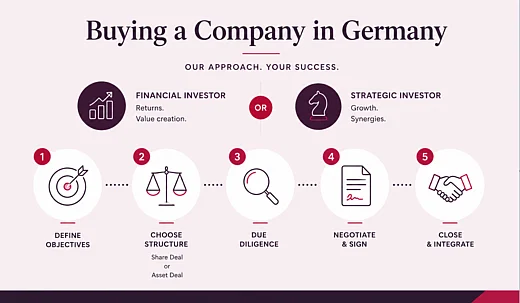
As a German business law firm, we advise and represent buyers throughout the acquisition of companies and shareholdings in Germany. A successful transaction begins with careful planning, including the definition of the acquisition objectives and the optimal transaction structure. We guide our clients through every stage of the process, from legal due diligence and risk assessment to contract negotiation, drafting, and the successful completion of the transaction.
Our M&A Expertise in German Company Acquisitions
At ROSE & PARTNER, our team of certified specialists for German corporate law and tax advisors supports buyers throughout every stage of a company acquisition in Germany. We provide strategic, legal, and tax advice to ensure a smooth and successful transaction while minimizing risks and maximizing value.
Our services include:
- Reviewing offers, information memoranda, and letters of intent (LOIs)
- Structuring the transaction and defining acquisition objectives
- Advising on the optimal acquisition structure (share deal vs. asset deal)
- Conducting comprehensive legal and tax due diligence
- Assessing legal, tax, and commercial risks
- Supporting purchase price negotiations, advising on purchase price mechanisms, earn-outs, and adjustment clauses
- Drafting and negotiating share purchase agreements (SPAs) and asset purchase agreements (APAs)
- Developing strategies to reduce buyer liability and transaction risks
- Coordinating tax aspects of the acquisition and post-closing integration
- Representing buyers in post-M&A disputes, including warranty claims, fraudulent misrepresentation, and breaches of contractual obligations
If you are considering the acquisition of a business in Germany, our M&A team will be pleased to discuss your project. Contact us by phone, e-mail, or via the contact form below for an initial, non-binding consultation.
When acquiring a company in Germany, buyers generally pursue either a financial investment strategy or a strategic business objective. Financial investors focus primarily on generating returns and increasing enterprise value, while strategic investors seek to strengthen their market position, expand their operations, acquire technology, or enter new markets.
The legal form of the target company (such as a GmbH, AG, KG, or GmbH & Co. KG) is usually not the key consideration at the beginning of the acquisition process. Instead, the transaction structure, commercial goals, and potential legal and tax risks are the factors that typically shape the acquisition strategy.
Buying a Company in Germany
Acquiring a company in the world-famous German Mittelstand offers massive stability and innovation. When buying a company, every international investor must understand some important things about the German market. The German attorney Boris Jan Schiemzik describes the key guidelines for investors.
Interests of the Buyer
The goal of financial investors is usually the realization of as high as possible, risk-adequate profits on the subsequent divestment. To this end, financial investors in Germany develop an exit strategy, at the end of which there is a profitable IPO of the acquired company or a lucrative sale, for example to an industrial partner.
The strategic investor usually aims to achieve synergy effects and diversification, i.e. horizontal or vertical product expansion of a group, with his entrepreneurial investment. However, the goals can also be the reduction of dependencies or the acquisition of new technologies, patents or research results. As a rule in German practice, the intention is to purchase brands, special know-how or technical expertise at favorable prices. Often, access to untapped markets or the acquisition of highly qualified management is also intended.
For all acquirers, the transaction objectives must be defined early on in the acquisition process. Aspects such as the amount of the subsequent purchase price, guarantees and liability, continued employment of managers, executives and personnel, non-competition clauses on the part of the seller, etc. must already be taken into account at this stage. In connection with the development of the transaction objectives, German tax law issues in particular must also be taken into account. The buyer regularly intends not only to pay a purchase price as low as possible, but also to claim tax relief on the purchase price as quickly as possible.
(Especially on the sale of a company from the seller's point of view).
Typification of the Company Purchase in Germany
The purchase of a company is generally based on a detailed purchase agreement. Depending on the interests of the company purchaser, the company purchase in german practice is carried out by way of a so-called share deal (purchase of the company shares) or an asset deal (purchase of the individual assets of the company). An asset deal is mainly considered if only a part or a division of a company is to be acquired and no or only certain liabilities are to be assumed. Finally, an asset deal may also be preferred by the purchaser for tax considerations, as the acquisition of a business by way of taking over individual assets can generate depreciation volume.
Depending on whether the company is acquired by way of an asset deal or a share deal, the provisions of the purchase agreement must be structured differently in Germany: From a contractual point of view, for example, there are differences in the design of the warranty clauses or guarantee provisions. In the case of an asset deal, separate provisions are made in the purchase agreement for liabilities and legal relationships with third parties who do not expressly agree to the purchase of the company and an assumption of the contract by the purchaser. Irrespective of this, it is necessary, both in the case of the acquisition of shares and the acquisition of individual assets, to review the individual contractual relationships and assets of the german company to be transferred.
Due diligence in the Acquisition of a Company in Germany
In the case of a company sale, usually only the seller has important information concerning the value and future earnings situation of the company. The buyer is usually much less well informed. In addition, the seller is inclined to provide only positive information that can increase the purchase price and to conceal negative information. German business practice shows that sellers are rarely confronted with claims for damages due to the disclosure of false information afterwards, since cause and damage are often difficult to prove.
The so-called due diligence process is intended to eliminate the information deficiency that typically exists on the part of the buyer. In the course of a due diligence process, the buyer is provided with a detailed and systematic analysis of the company's data. On the other hand, the seller can reduce his liability risk by disclosing value-forming factors and legally relevant data. From the buyer's perspective, due diligence thus enables a risk and value assessment as well as the preservation of evidence.
The buyer can only form a coherent picture of the value and risks of the company to be purchased if he examines and correctly interprets the business, market-relevant, tax and legal framework conditions. In the course of the legal examination (legal due diligence), questions from the following areas often have to be answered and regulated by the german purchase agreement:
- Appropriate warranty and guarantee rules, assurances and liability rules;
- Purchase price, purchase price adjustment;
- Liability for old liabilities;
- Liability risks for share purchasers due to open deposits;
- German Labor law problems, safeguarding the transfer of business;
- German antitrust law requirements;
- Tax and social security regulations;
- Statutes of limitation;
- Restrictions on competition for the seller;
- Arbitration clauses.
Advising the Buyer on the Acquisition of a Company
A company acquisition requires careful preparation in German practice. Only after the necessary information has been made available a buyer can even enter into contractual negotiations.
Lawyers support the buyer of a company by looking after his interests in the preparation of the company transaction, for example in the examination of the company exposé handed over by the buyer, in the examination of the letter of intent or in the performance of the due diligence in German and English.
Professional advice by lawyers and tax advisors already in the preparatory phase often saves the buyer of a company high costs. Already in the preparatory phase, it is important to reduce the liability risks of the buyer (for example, in the drafting of confidentiality agreements or by breaking off the contract negotiations) as well as to push the information gathering professionally.
Of course, the drafting and negotiation of the purchase agreement also belongs in the hands of a specialized German commercial law firm. The adjustment of the various legal parameters is just as important as the tax-optimized acquisition process to be developed by the tax lawyer or tax advisor.
Law firms accompanying the transaction should also represent the interests of the buyer in the post-contractual phase (M&A litigation), for example if contractual guarantees and assurances prove to be false after the transaction and claims against the seller have to be enforced on this basis. Finally, the conclusion of an M&A insurance policy to secure the purchase of the investment can also be a topic of advice. For more details, please click here: M&A insurance in Germany
If you intend to purchase a company in Germany and have questions regarding the purchase process, our lawyers in our offices in Hamburg, Berlin, Munich, Frankfurt and Cologne are at your disposal at any time.
Evaluation from our expert!
In our team, tax advisor Martin Stürmer takes care of the company valuation for the determination of the purchase price. As a specialized expert, he works together with our lawyers in german corporate law. You can also engage him independently of a legal mandate.
Ask for a quote for a business valuation or a cost-effective indicative business valuation:
Post-M&A Disputes
Disputes in German practice often arise when the seller of a company remains with the company as an executive or managing director after the transaction has been completed. When a dispute arises in Germany, it quickly leads to dismissals, terminations and even bans from the company. Typical areas of conflict are also so-called purchase price adjustment clauses and contractual guarantees. Post M&A disputes in connection with downstream purchase price payments (so-called "earn-outs") are also almost classic.
Finally, the stakes are particularly high when the seller is accused of fraudulent misrepresentation or even fraud. In addition to high claims for damages, the seller may even face criminal prosecution. A good legal defense is essential here.
Further information on disputes after the purchase of a company can be found here: Dispute after company purchase
Q&A – Company Aquisition in Germany
Click here to find answers to the most frequently asked questions concerning buying a company under German law.
What are the main risks for buyers in a German company acquisition?
Typical risks include undisclosed liabilities, tax exposures, employment law issues, pending litigation, compliance violations, inaccurate financial information, and breaches of contractual warranties.
Why is due diligence essential when buying a company in Germany?
Due diligence enables the buyer to identify legal, tax, financial, and operational risks before signing the transaction documents. It reduces information asymmetry between buyer and seller and provides the basis for negotiating the purchase price, warranties, indemnities, and other contractual protections.
What is the most common acquisition structure in Germany?
Company acquisitions in Germany are typically structured either as a share deal or an asset deal. In a share deal, the buyer acquires the shares of the target company. In an asset deal, the buyer acquires selected assets and business operations. The appropriate structure depends on legal, tax, and commercial considerations.
Why is it important to define transaction objectives at an early stage?
Clearly defined transaction objectives help determine the optimal acquisition structure, purchase price mechanism, financing strategy, and post-closing integration plan. They also influence key contractual issues such as warranties, liability provisions, management retention, and non-compete obligations.